

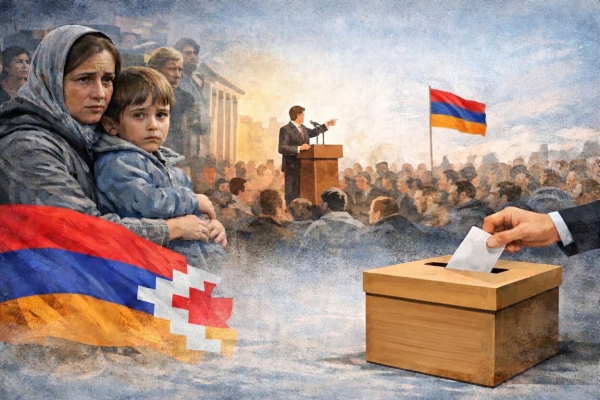
This image was generated using AI and is for illustrative purposes only. Any resemblance to real people or events is coincidental.
By Tigran Grigoryan and Hayk Khanumyan
Following the ethnic cleansing that took place in Nagorno-Karabakh in September 2023 and the forced displacement of the entire population, numerous challenges continue to persist in the process of integrating refugees from Nagorno-Karabakh in Armenia. Over the past two and a half years, the majority of international and Armenian stakeholders have focused on addressing challenges related to the socio-economic integration of refugees. However, among the most significant factors hindering the integration of Nagorno-Karabakh refugees are the hate speech generated against them and the issue of their civic participation.
The Regional Center for Democracy and Security (RCDS) is one of the few Armenian and international organizations that has been working in recent years specifically to address these issues and challenges. Based on our previous research and experience on this topic, we have observed that during periods of heightened domestic political tensions, narratives targeting refugees and hate speech against them increase sharply.
In this regard, the parliamentary elections scheduled for June, as well as the pre-election and post-election periods, warrant particular attention for the monitoring, documentation, and development of recommendations concerning hate speech targeting refugees. In the coming months, RCDS will prepare four short reports dedicated to this topic, which will later be consolidated into a more comprehensive report on hate speech targeting Nagorno-Karabakh refugees.
In these reports, we will use the following general definition of hate speech included in the United Nations’ strategy and plan of action on hate speech: “Any kind of communication in speech, writing or behaviour, that attacks or uses pejorative or discriminatory language with reference to a person or a group on the basis of who they are, in other words, based on their religion, ethnicity, nationality, race, colour, descent, gender or other identity factor.”
The Effective Start of the Election Campaign and Hate Speech Against Refugees
March 2026 was an active month both in terms of political campaigning by various forces and the practice of targeting Nagorno-Karabakh refugees. Prime Minister Nikol Pashinyan, his Civil Contract party, and media outlets under their control have in recent weeks regularly targeted Nagorno-Karabakh refugees, primarily employing two stigmatizing narratives: the narrative of “deserter Karabakhis” and the narrative of “ungrateful Karabakhis.”
A new wave of hate speech against refugees was triggered by an incident involving Nikol Pashinyan in the Yerevan Metro. On March 22, 2026, during a campaign activity in the metro, Pashinyan approached a woman from Nagorno-Karabakh (Armine Mosiyan) and her child, attempting to present them with a pin in the shape of the map of the Republic of Armenia. The woman refused, explaining her reasons, after which Pashinyan continued to argue with her despite her request to stop the conversation. He then raised his voice and spoke to her while pointing his finger. Moreover, when the woman urged him not to raise his voice or gesture in that manner, he stated that he would continue speaking that way, declaring that billions earned by the citizens of Armenia had been spent to sustain Armenians in Artsakh, and that “Next time, you runaways, don’t try to say that I gave away Karabakh.”
Immediately after the incident, media outlets under the control of the ruling party began disseminating hate speech and disinformation about Mosiyan and Nagorno-Karabakh refugees. Although Pashinyan eventually apologized to Mosiyan following significant public pressure, pro-government media continued spreading disinformation and hate speech.
Initially, these media outlets began circulating past social media posts made by Mosiyan years earlier, in which she had targeted Pashinyan and his supporters. Subsequently, false claims were attributed to her that she had never made.
In particular, Araratnews.am produced a short video about the incident, which stated: “Today, in the Yerevan metro, Prime Minister Nikol Pashinyan became agitated while speaking with an Artsakhi girl, because the latter, in response to the map of the Republic of Armenia addressed to her, disdainfully said that she does not accept Armenia, does not care about it, and that neither she nor her child need the Republic of Armenia.”
Mosiyan had made no such statements during the incident; however, this falsehood was also circulated by Medianews.site, whose links to the Deputy Chief of Staff of the Prime Minister, Taron Chakhoyan, had previously been exposed through an investigation by Infocom.
CivilNet’s fact-checking team refuted this false claim, but it nevertheless significantly increased the volume of hate speech directed at Mosiyan and Nagorno-Karabakh refugees.
The editor-in-chief of AraratNews prior to the Velvet Revolution (2013–2018) was Alen Simonyan, the current Speaker of the National Assembly. The website’s former editor, Emma Palyan, is now a member of parliament from the ruling faction. The outlet is associated with ruling party MP and businessman Khachatur Sukiasyan and his family.
Medianews also began amplifying posts by Facebook users targeting Armine Mosiyan and Nagorno-Karabakh refugees. For instance, immediately after the metro incident, the outlet published a post by Facebook user Shogh Movsisyan. Justifying Nikol Pashinyan’s words and actions toward the woman from Nagorno-Karabakh and refugees more broadly, the user referred to Mosiyan and “people like her” as “chushka” (a Russian slang term meaning an uncultured or low-status person). Moreover, the user argued that Nagorno-Karabakh refugees who express disagreement with the authorities should not be granted citizenship.
“…This one and others like her should be afraid to leave their homes. …Enough of granting citizenship left and right to every ‘Turk’s darling’ without checking their background for seven generations,” the user wrote. Medianews chose as the headline for this piece the following excerpt from Movsisyan’s post: “Before this unwashed one opens her mouth and pours curses on our heads, she should use her nonexistent brain to think about the consequences she will face.”
Medianews also disseminated a post by pro-government user Natali Aleksanyan targeting Nagorno-Karabakh refugees, which was again based on the aforementioned false claim regarding Armine Mosiyan. The article was titled: “I will never forgive this woman; in the metro she said she does not care about Armenia: Aleksanyan.”
Another pro-government user also targeted Armine Mosiyan, again relying on the fabricated claim attributed to the woman from Nagorno-Karabakh. Medianews amplified this post under the headline: “Are there still people defending someone who does not care about Armenia?: Ara Hakobyan.”
The Narrative of “Deserter Karabakhis”
In a briefing on March 26, Nikol Pashinyan continued the narrative of “runaways” used during the metro incident and once again targeted Nagorno-Karabakh refugees, casting doubt on the fact of resistance by the Artsakh side during the September 2023 Azerbaijani attack. “Following the events of 2023, a meeting was held in the Security Council of the Republic of Armenia, where the results of the military operations were analyzed,” Prime Minister Nikol Pashinyan stated during the briefing. He added: “I want to note that the claims about fighting and so on, to put it mildly, do not correspond to reality, because according to the data available to our intelligence and not only intelligence, the lion’s share of the available weapons and ammunition—this may be 80%, it may be 90%—remained untouched…”
It is noteworthy that, according to official Azerbaijani data, during the one-day war of September 2023, the Azerbaijani side suffered more than 700 casualties, including 205 killed.
Nikol Pashinyan’s narrative of “deserter Karabakhis” was advanced by Roman Baghdasaryan, a pro-government blogger with a large audience, known for his posts targeting Nagorno-Karabakh refugees and for his participation in events organized by Anna Hakobyan, Nikol Pashinyan’s ex-wife. Referring to an alleged conversation between a woman from Nagorno-Karabakh and Nikol Pashinyan in Charentsavan, in which the woman blamed the Prime Minister for the loss of Nagorno-Karabakh, Baghdasaryan stated that during the 44-day war doctors and nurses had asked Nagorno-Karabakh women to help in hospitals, but that they either fled to Yerevan or stayed in basements, arguing that such women have no right to question the Prime Minister. He then resorted to insults: “I think you are cattle, you are inhumane animals.”
Expressing outrage at the alleged question addressed to the Prime Minister, Baghdasaryan further claimed that Nagorno-Karabakh women had fled to Yerevan in their thousands with their husbands on the very first day of the war. He continued developing the theme of allegedly refusing to assist the wounded in another video posted on his Facebook page, this time targeting Armine Mosiyan and using insulting language while spreading hate speech against Nagorno-Karabakh refugees: “Yesterday I watched a video about a woman from Karabakh. That woman thinks we have no memory and does not know who they are—the women of Karabakh. During the 44-day war, that Karabakh woman and people like her refused to take care of our wounded in Karabakh hospitals. Doctors and nurses were asking women to come and help the wounded, but those heartless people either fled to Armenia or stayed in basements.”
In his videos, the pro-government blogger states that he himself is from Nagorno-Karabakh, continuing: “No Karabakh Armenian has the right in Armenia, no Karabakh Armenian should say a single word, any bad word, against the Prime Minister. No Karabakh Armenian has the right to make any remark about this government, because the majority of us are not fighters, we are looters, we have looted our country, our home, Karabakh, we did not love Karabakh, and most of us do not know where God is,” concluding that Pashinyan’s single hair is more important to him than all Karabakh Armenians.
In recent years, Baghdasaryan has been engaged in spreading disinformation and hate speech against Nagorno-Karabakh refugees. For example, in the spring of the previous year, when refugees from Nagorno-Karabakh were protesting against the reduction of a key social assistance program for forcibly displaced persons by the government, Baghdasaryan wrote on his Facebook page that only 12–14 percent of recipients of assistance were honest people who had not committed crimes. He also accused Nagorno-Karabakh officers of deliberately killing peaceful residents of Yerevan and soldiers. A criminal case was initiated regarding this post a year ago, within the framework of which no developments have been reported to date.
The Narrative of “Ungrateful Karabakhis”
The Prime Minister’s statement during the metro incident that “we have spent billions earned by the citizens of Armenia so that you could stay there [in Artsakh],” which is part of the narrative of “ungrateful Karabakhis,” was further developed by Arsen Torosyan, Minister of Labor and Social Affairs and member of the Civil Contract party board. He claimed that since its very establishment, Nagorno-Karabakh has been sustained at the expense of Armenians from Armenia. The Minister accused Armine Mosiyan of displaying an “aggressive” and “contemptuous” attitude toward the map of Armenia. “It is very surprising that, living in the Republic of Armenia and receiving essentially everything from us, from the state, all our support programs—and not even mentioning the support they received while living in Karabakh before these programs—it is well known that Karabakh, since its creation, if one may say so, has existed thanks to the Republic of Armenia, thanks to the citizens of the Republic of Armenia, and having such a contemptuous attitude toward the Republic of Armenia makes it difficult to restrain emotions,” Torosyan stated.
This narrative was also actively circulated by Roman Baghdasaryan. In his video targeting Armine Mosiyan and Nagorno-Karabakh refugees, he stated: “For 35 years Armenia and the diaspora fed you—the parasites of Karabakh, while you refused to care for the wounded in hospitals. The Armenian people will never forget your heartlessness and inhuman behavior, and those who refused to care for our wounded in Karabakh were justly expelled from Karabakh by God.”
Targeting of refugees by opposition actors
Some opposition figures are also involved in the targeting of Nagorno-Karabakh refugees. On March 18, 2026, Prime Minister Nikol Pashinyan participated in a conference titled “Inclusive Development: Achievements and Next Steps,” dedicated to the issues of persons forcibly displaced from Nagorno-Karabakh and steps toward addressing them. The event was attended mainly by refugees from Nagorno-Karabakh working in state and community institutions. Some of them expressed gratitude to Nikol Pashinyan and the Government of Armenia for the refugee support programs, after which they were targeted.
In this context, former regional governor and ambassador Edgar Ghazaryan, who is included in the electoral list of the opposition alliance formed by the “Strong Armenia” party, commented on one of the participants and drew parallels with Nazi Germany. Posting a photo of a Nagorno-Karabakh Armenian working in a regional administration office who had thanked Nikol Pashinyan during the aforementioned discussion, Ghazaryan wrote: “No Jew in the Auschwitz concentration camp ever thanked Adolf Hitler for genocide and forced displacement, yet this young man living in Ashtarak today thanked Nikol Pashinyan for the forced displacement of the Armenians of Artsakh and the loss of Karabakh. These people must be recognized by face. The young man in the photo is that person.”
Through this statement, Ghazaryan effectively targeted not only participants of the event but also all refugees who hold pro-government views. Targeting refugees based on political views is not a new phenomenon. It is actively practiced by the ruling party as well. In effect, regardless of which political force refugees support, political actors from different camps consistently target them based on their political preferences. This constitutes a serious obstacle to the integration of refugees into Armenia’s political and civic life.
At the same time, it should be emphasized that the scale and nature of hate speech targeting refugees by the ruling party and opposition groups are not comparable. In the case of the ruling party, the targeting of refugees is much more extensive, systematic, and also involves the use of media outlets with large audiences.
Conclusion
As expected, following the de facto start of the pre-election period, the volume of hate speech against Nagorno-Karabakh refugees has significantly increased. Hate speech is mainly disseminated by ruling or pro-government actors, as well as by media outlets controlled by the authorities.
The targeting of refugees has a systematic character and is implemented through a clearly structured mechanism, whereby media outlets controlled by the ruling party simultaneously republish and disseminate the same social media posts targeting Nagorno-Karabakh refugees.
At the same time, refugees are targeted for their views, regardless of their political affiliation. This behavior by both government and opposition actors creates obstacles to the integration of Nagorno-Karabakh refugees into Armenia’s political and civic spheres.
The instrumentalization of malign narratives about Nagorno-Karabakh Armenian by political actors contributes to the spread of hate speech against refugees at the societal level, reinforcing existing stereotypes and prejudices toward this vulnerable group. The inaction of law enforcement institutions also contributes to the dissemination of such harmful narratives and discriminatory attitudes.
This report was produced with the financial support of the European Union and the German Marshall Fund of the United States – Transatlantic Foundation (GMF TF). Its contents are the sole responsibility of the Regional Center for Democracy and Security and do not necessarily reflect the views of the European Union or the GMF TF.